Hardwood floor water damage in Portland: what can be saved and what can't
Cupping, crowning, and buckling explained, why Portland homes are especially at risk, the 24 to 72 hour window that decides everything, and when floors can be sanded flat versus replaced.
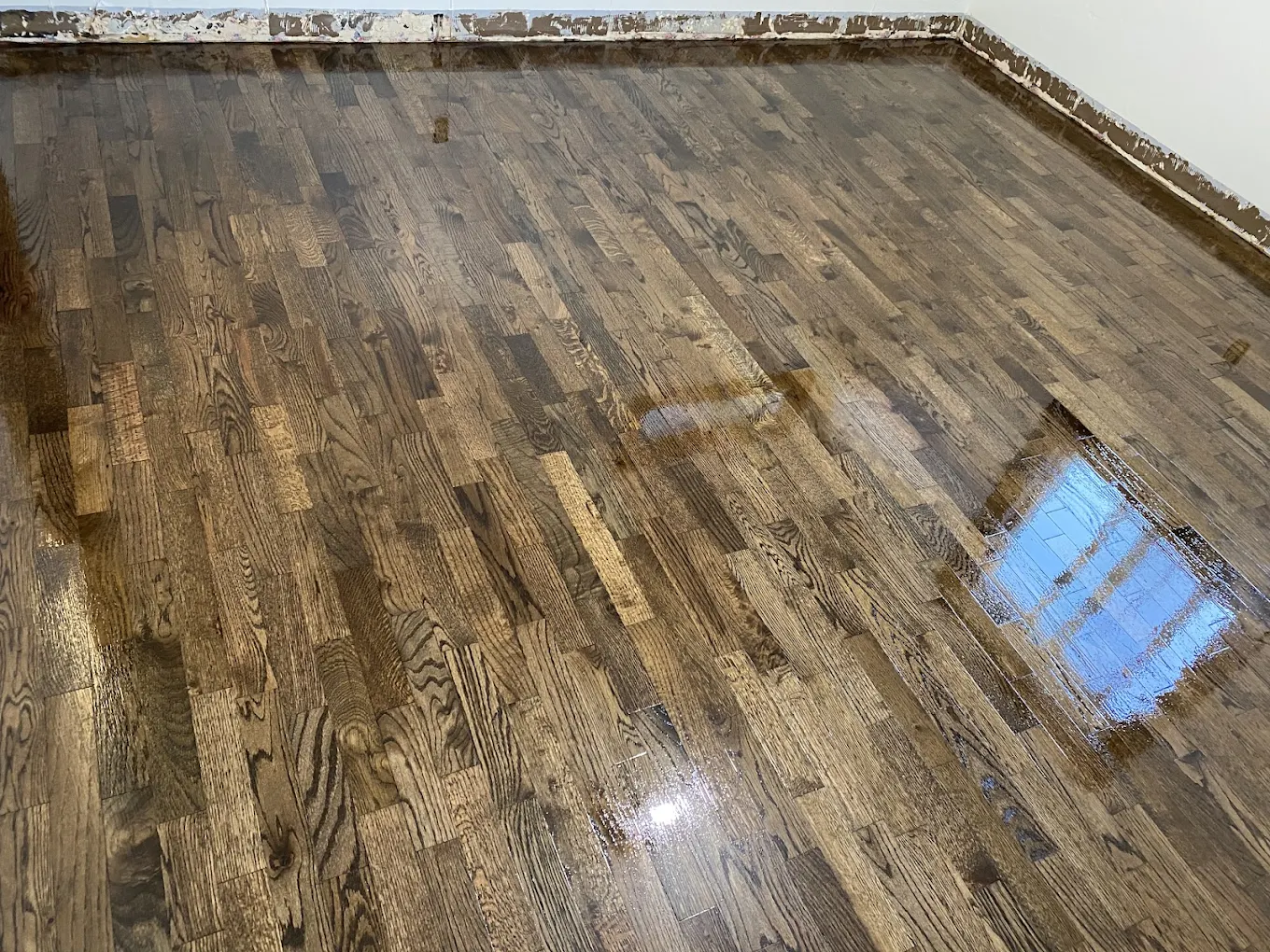
If your hardwood floors suffered water damage in Portland, your three options after drying (to 6%–9% moisture content) are: (1) Dustless sanding and refinishing ($4.99–$6.95/sq ft) for mild cupping and surface stains, (2) Surgical board weave-in repair ($450–$950) for localized appliance or pipe leaks, or (3) Full section replacement ($11.00–$16.00/sq ft) for buckled boards or rotted subfloors.
Portland hardwood floor water damage repair options and 2026 costs
Every winter, usually right after the first big storm rolls through the Willamette Valley, our phone starts ringing with the same question: "Water got on my hardwood floors. Are they ruined?"
The honest answer depends mostly on two things: how long the water sat there, and how quickly you act now. We have seen floors survive a burst pipe that flooded a whole kitchen, and floors ruined by a refrigerator line drip nobody noticed for six months. At Flooring PDX, we have restored water damaged floors all over Portland, from Craftsman bungalows in Sellwood to newer builds in Bethany. Here is our plain guide to what can be saved and what cannot.
Cupping, crowning, and buckling: what water actually does
Wood absorbs moisture like a sponge and swells as it does. The shape your floor takes after a water event tells us where the moisture came from and how severe the damage is.
Cupping
The most common form we see in Portland. The edges of each board rise higher than the center, so the floor feels like shallow waves under bare feet. It happens when the bottom of the boards is wetter than the top, usually from a damp crawlspace, a wet slab, or standing water that seeped between the boards. The good news: mild to moderate cupping is often reversible if the floor dries out properly.
Crowning
The opposite. The center of each board sits higher than the edges. It usually means the top got wet while the bottom stayed dry, or, more commonly, someone sanded a cupped floor before it finished drying. When the boards later dry and shrink, the sanded edges end up lower than the middle.
Buckling
The severe one. Boards swell so much they pull loose from the subfloor and lift, sometimes several inches, usually after days in standing water. A buckled floor almost always requires replacement of the affected boards, and sometimes subfloor repairs beneath them.
Why Portland homes are especially at risk
Our climate and our housing stock work against us here. A few patterns come up again and again:
- Winter storms and freezing snaps. During Portland's January ice events, pipes freeze in uninsulated crawlspaces and exterior walls, then burst when they thaw, often while homeowners are out of town.
- Old plumbing in Craftsman homes. Many houses in Irvington, Alameda, Hawthorne, and Mount Tabor still have original galvanized supply lines, 80 to 100 years old, that corrode from the inside and fail with little warning, often inside a wall or under a kitchen.
- Basement and crawlspace moisture. Months of rain saturate the soil around Portland foundations. Without a vapor barrier, moisture migrates up through the subfloor into the wood from below, producing the widespread cupping we covered in our guide to how Portland humidity makes hardwood floors expand.
- Everyday appliance failures. A pinhole leak under a dishwasher can quietly feed water into oak flooring for months.
To get ahead of these problems, see our article on protecting hardwood floors from Oregon weather.
The first 24 to 72 hours decide almost everything
Wood does not absorb water instantly. Solid oak can usually tolerate surface water for a day or so before serious swelling begins. That window closes fast. If water gets on your floor:
- Stop the source. Shut off the supply valve or the main. Nothing else matters until the water stops coming.
- Remove standing water fast. Towels, a mop, a wet/dry vacuum. Every hour it stands, more water works into the seams between boards.
- Move rugs and furniture off the wet area. Rugs trap moisture, and furniture legs leave pressure marks in softened wood.
- Get air moving. Fans across the surface, a dehumidifier in the room, heat on in winter. Avoid direct high heat, which can crack the wood.
- Call for help early, not late. A water mitigation company with drying mats can pull moisture out before permanent damage sets in. For the floor itself, request a free assessment as soon as the source is controlled. Seeing a floor on day two instead of day twenty changes what we can save.
The floors we lose are almost never the ones where the homeowner acted within 72 hours. They are the ones where the water sat, or where the floor "looked okay" once the surface dried and nobody checked further.
Drying takes longer than anyone expects
Here is the part that surprises people: a floor that got seriously wet can take 4 to 8 weeks to fully dry, longer for thick solid boards over a damp crawlspace. The surface may look dry within days, but the core of the boards and the subfloor hold moisture much longer.
We check this with a moisture meter, not with our eyes. Before sanding or repairing anything, we want boards reading within about two percentage points of the unaffected flooring nearby, and the subfloor dry too. Sanding a floor at 14 percent moisture turns a cupping problem into a crowning problem.
Patience here is not wasted time. Many cupped floors flatten out substantially on their own once they reach equilibrium, and what looked like a replacement in week one becomes a refinish in week six.
What can be sanded flat, and what must be replaced
Once the floor is genuinely dry, the decision is fairly simple.
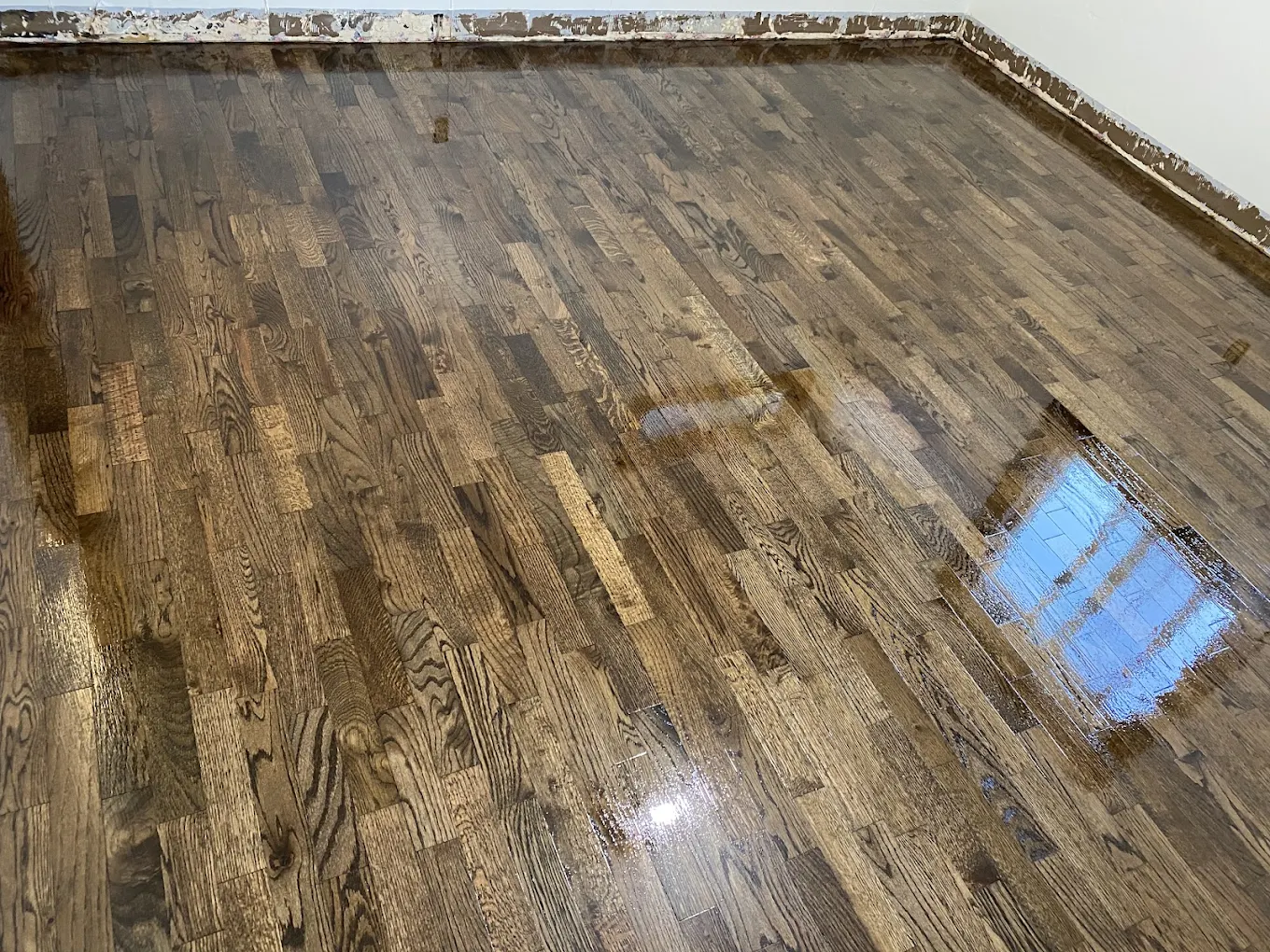
Good candidates for sanding and refinishing: mild to moderate cupping that has mostly relaxed after drying, water stains and gray discoloration in the upper wood fibers, raised grain, and minor edge damage, on floors with enough wear layer left. A full sanding and refinishing removes the damaged fibers, flattens residual cupping, and gives you a fresh finish across the room. In Portland this typically runs $4 to $7 per square foot, a fraction of replacement cost.
Boards that need replacement: buckled boards that lifted off the subfloor, deep black staining (a sign of prolonged moisture and often mold underneath), splits, delamination on engineered products, rot you can dent with a fingernail, and any board over a compromised subfloor.
Weave-in repairs: replacing boards without replacing the floor
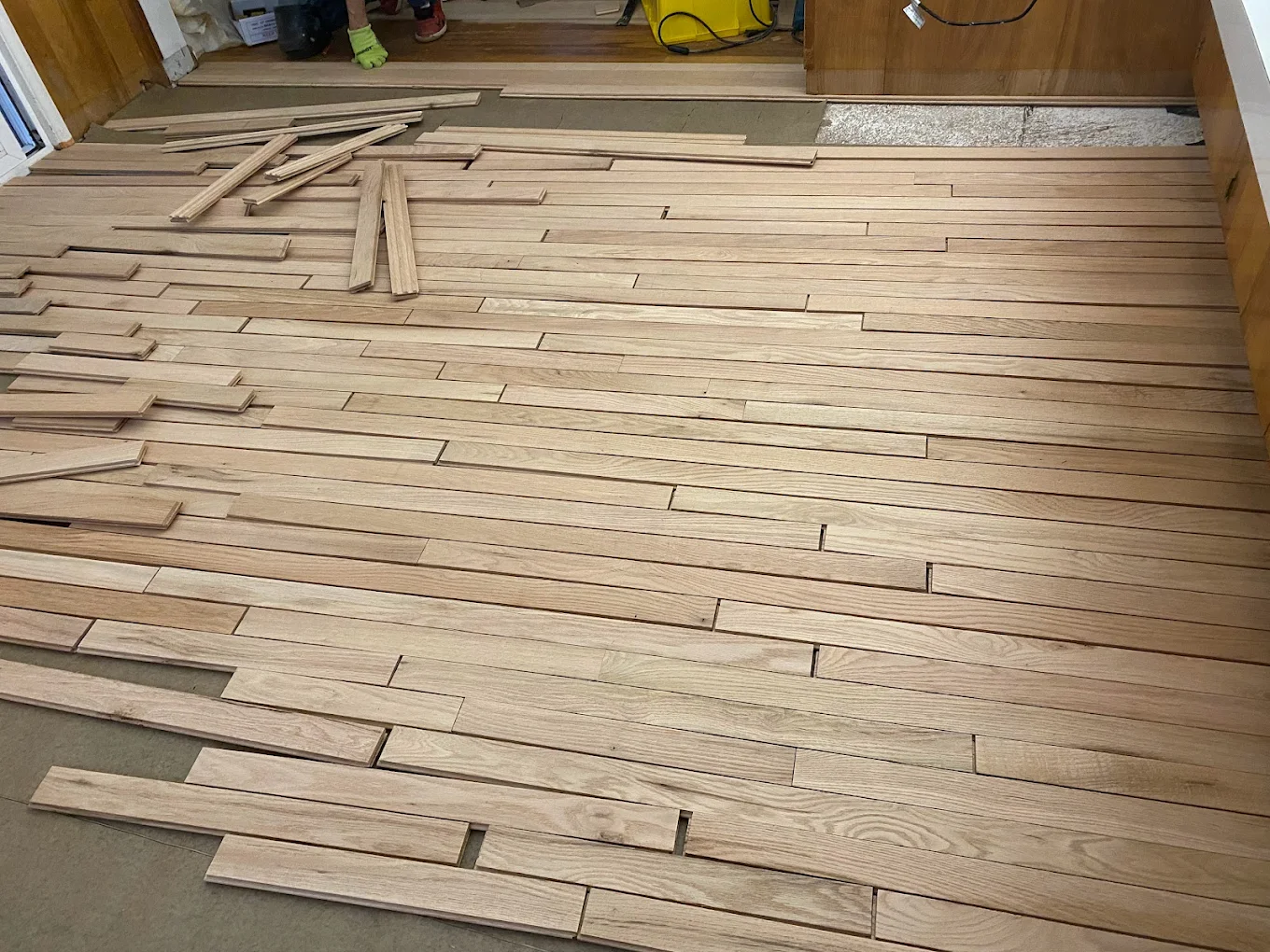
You do not need a new floor because ten boards died under the dishwasher. The standard fix is a weave-in repair, sometimes called lacing in: we cut out the damaged boards, stagger the cuts so there is no straight repair line, and weave new boards of the same species and width into the existing pattern. Sanded and finished with the surrounding floor, the repair disappears.
The catch is matching. Old-growth fir and vintage oak have color and grain that new stock does not match off the shelf, so we often source reclaimed material or blend stain across the room. This is exactly what our hardwood floor repair service exists for. Small weave-in repairs commonly land in the $300 to $800 range, plus refinishing if the whole room needs to blend, and we confirm the scope in person before any numbers become a quote.
Document everything for your insurance claim
Sudden water damage from a burst pipe or failed appliance is usually covered by homeowners insurance. Slow leaks and ground moisture often are not. Either way, documentation makes or breaks the claim:
- Photograph and video everything before cleanup, and keep documenting as things develop, since cupping can worsen over days.
- Save the failed part. The burst supply line or cracked fitting is evidence of a sudden failure.
- Get moisture readings on record. Mitigation companies log daily readings that prove how far the damage extended.
- Get a written estimate from a flooring contractor, not just a restoration company. Insurers routinely underestimate what it costs to match and blend hardwood. A proper estimate covers board replacement, refinishing the full area so sheen and color match, and baseboard work.
- Do not let anyone rush a rebuild over a wet subfloor. If a contractor wants to install new flooring two weeks after a flood, ask for moisture readings first.
Not sure what you are looking at? Ask us
If your floor is cupped, stained, or lifting, send us photos or have us out to look. We will measure the moisture, tell you honestly whether the floor needs time, sanding, or board replacement, and put together a clear written estimate you can also use for your insurance file. Request your free quote or call Vasi directly at 503-388-1689. The earlier we see it, the more of your floor we can usually save.
Frequently asked questions
Can a cupped hardwood floor flatten out on its own?
Often, yes. If the moisture source is fixed and the floor dries evenly over several weeks, mild to moderate cupping usually relaxes most of the way back down, and any leftover waviness can be sanded flat once moisture readings return to normal. The mistake to avoid is sanding too early, because a floor sanded flat while still wet will crown as it dries.
How long should I wait before refinishing a water damaged floor?
Plan on 4 to 8 weeks for a floor that took on significant water, and let a moisture meter make the call rather than the calendar. Boards should read within about two percentage points of unaffected flooring nearby, with a dry subfloor, before any sanding starts. Thick solid boards over a crawlspace can take longer in a wet Portland winter.
Does homeowners insurance cover hardwood floor water damage in Oregon?
Sudden and accidental events, like a burst pipe or a failed water heater, are typically covered under standard homeowners policies. Gradual damage from slow leaks or ground moisture is usually excluded, and outside flooding generally requires separate flood coverage. Document everything immediately, save the failed part, and get a written estimate from a flooring contractor so the claim reflects the real cost of matching hardwood.
Is it worth replacing just a few damaged boards, or should I redo the whole floor?
If the damage is localized and the rest of the floor is sound, a weave-in repair is almost always the more sensible option, typically a few hundred dollars instead of many thousands. The trade-off is blending: to make the repair invisible, the area usually needs sanding and refinishing along with the surrounding floor. We walk through both options with real numbers on site.
Topics