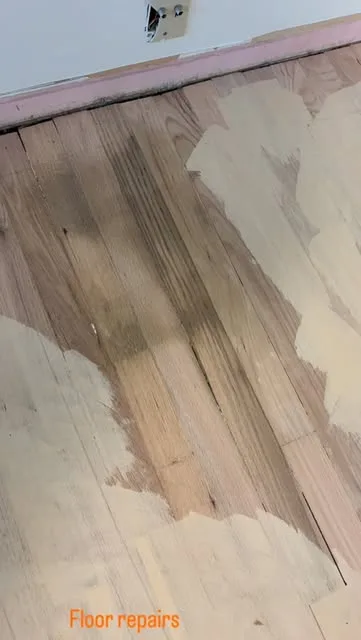
Standalone hardwood floor repair in Portland starts at an $875 minimum mobilization plus $25 per laced-in board, with typical standalone structural, pet-stain, or water-damage repair scopes ranging from $875 to $2,400 depending on board count, historic milling, and subfloor drying. When board repairs are bundled with full dustless refinishing ($4.99 to $6.95 per square foot), the $875 standalone mobilization is waived and individual board lace-ins are billed as a simple $25 per board add-on. Direct owner pricing by Vasi Popovici (Oregon CCB #227332) with 160+ 4.9★ reviews.
Unlike whole-house refinishing or installation, hardwood repair pricing depends on whether our crew is mobilizing solely for an isolated patch or weaving replacement boards ahead of continuous room sanding across Portland Craftsman and Mid-Century homes.
Below is our verifiable 2026 pricing benchmark derived from completed restoration projects across the Portland metropolitan area.
Standalone repair mobilization vs. bundled refinishing add-ons
Quick answer: Standalone hardwood floor repair in Portland starts at an $875 base mobilization plus $25 per laced-in board, with typical isolated pet stain or water damage repairs running $875 to $2,400. When bundled with full 99.8% HEPA refinishing ($4.99 to $6.95 per sq ft), Flooring PDX waives the $875 mobilization fee.
Understanding the difference between standalone repair visits and bundled board replacements helps homeowners avoid overpaying for small fixes:
- Bundled board repair during full refinishing ($25 per board add-on): Because our HEPA sanding trailers, moisture meters, and finish equipment are already set up on site for full refinishing ($4.99 to $6.95 per square foot), we waive the standalone mobilization fee completely and charge $25 per laced-in plank for standard oak or fir stock.
- Standalone repair mobilization ($875 minimum + $25 per board): Dedicated repair-only trips require crew dispatch, dust containment setup, surgical tongue-and-groove extraction, Delmhorst moisture testing, custom stain matching, and multi-coat Bona Traffic HD blending, resulting in typical standalone totals between $875 and $2,400.
Average repair pricing by common floor issue
1. Board replacement and weave-in repairs ($875 standalone base or $25 per board bundled)
When individual boards are cracked, deeply gouged, or burned near hearths, we unfasten the damaged planks and lace in matching tongue-and-groove boards.
- Standalone mobilization base: $875 minimum mobilization
- Laced-in matching boards: $25 per board (both standalone and when bundled with full refinishing)
- Stain and sheen blending: Included in whole-room refinishing or blended across surrounding planks during standalone visits.
2. Pet urine stain remediation ($875 to $1,650 standalone; $25 per board bundled)
Pet urine contains acidic moisture and ammonia that react with the natural tannins in oak, turning the wood dark gray or black. Because this discoloration often penetrates the full 3/4-inch thickness of the board, surface sanding will not remove it. We extract the darkened boards, seal or treat affected subfloor framing, and weave in fresh matching oak.
3. Water damage and cupping restoration ($875 to $2,400 standalone)
Plumbing leaks, refrigerator line breaks, or window condensation cause hardwood planks to absorb water, expand, and push upward at the edges (cupping).
- Stage 1 (Moisture baseline): We verify the wood's moisture content with pinless and pinned meters. Floors must dry to 6% to 9% EMC and within 2% to 4% of the subfloor before sanding or replacement.
- Stage 2 (Board weaving): Permanently crowned, split, or buckled boards are removed and replaced with properly acclimated stock.
4. Squeaky floor and loose subfloor stabilization ($875 standalone or bundled add-on)
Floor squeaks are caused by hardwood planks rubbing against loosened subfloor nails or joists. We fasten the subfloor from above using specialized countersunk breakaway screws or reinforce accessible crawlspace blocking, eliminating movement without marring the wood surface.
2026 Portland metro repair cost comparison table
Contractor quote comparison for hardwood floor repairs
Factors that influence your repair bid
- Species availability: Standard 2-1/4 inch select red and white oak are readily available. Antique vertical-grain Douglas fir or custom-milled widths may require sourcing reclaimed Portland architectural lumber.
- Subfloor moisture: Active crawlspace moisture must be corrected before closing up repairs to prevent repeat cupping.
- Finish blending: If the surrounding room has an aged oil-based finish, spot repairs may show slight sheen differences unless the entire continuous area is screened and topcoated with Bona Traffic HD.
Water damage, appliance leaks, and insurance claim documentation
Slow leaks from dishwashers, refrigerator ice-maker supply lines, radiant heating manifolds, and exterior patio doors are the leading causes of cupped or buckled hardwood floors in the Portland metro area. Attempting to sand a wet, cupped floor before the wood reaches equilibrium will permanently dish out the board edges and ruin the floor once it dries.
- Delmhorst EMC moisture verification (6%–9% target): Before any board replacement or flat sanding begins, we test both the hardwood planks and the plywood or shiplap subfloor using calibrated Delmhorst moisture meters. In the Pacific Northwest, wood flooring must stabilize to a baseline equilibrium moisture content (EMC) of 6% to 9% (and within 2% to 4% of the subfloor) after mitigation drying.
- Selective board weaving vs full replacement: Once dry, many moderately cupped solid oak or Douglas fir floors can be flattened with precision multi-stage drum and planetary sanding, requiring selective board weaving only where planks have split, delaminated, or buckled off the subfloor.
- Itemized insurance claim documentation: For homeowners filing water damage insurance claims, we provide clear, itemized written repair estimates separating damaged board extraction, subfloor prep, matching species weave-in, and continuous-room finish blending, accompanied by documented moisture readings for your insurance adjuster.
How we inspect and bid your floor repair
We do not provide vague ballparks or surprise change orders. Vasi Popovici visits your home, inspects the damaged area with moisture testing equipment, and provides a clear written estimate guaranteed for 30 days.
Frequently asked questions about hardwood floor repair costs
How much does it cost to replace a few damaged hardwood boards in Portland?
Standalone board replacement and weave-in repair in Portland starts at an $875 minimum mobilization plus $25 per laced-in plank. However, if you bundle board repairs with full dustless refinishing ($4.99 to $6.95 per square foot), the $875 mobilization is waived and matching boards cost just $25 per plank.
Can black pet urine stains be sanded out or do boards need replacement?
Deep black pet urine stains react with oak tannins through the full 3/4-inch thickness of the board and cannot be sanded out. We extract the stained planks and weave in fresh matching oak ($875 to $1,650 for standalone visits, or $25 per board when paired with whole-room refinishing).
How much does water-damaged hardwood floor repair cost in Portland?
Standalone repair for dishwasher, refrigerator, or patio-door water damage typically ranges from $875 to $2,400 for 15 to 50 square feet, including Delmhorst EMC moisture verification (6% to 9% target), board lacing, and Bona Traffic HD finish blending.
Do you provide itemized estimates for homeowner insurance water damage claims?
Yes. We provide detailed written repair scopes separating water-damaged board extraction, subfloor prep, matching species weave-in, and continuous-room finish blending along with calibrated moisture readings for insurance adjusters. Request a free repair estimate.